
The Learning Styles myth debunked on the back of an envelope
Feb 18, 2016
"You don’t have to believe in learning styles theories to appreciate differences among kids, to hold an egalitarian attitude in the midst of such differences, and to try to foster such attitudes in students." Daniel Willingham, Learning Styles FAQThe Learning Styles myth, for those that aren't already clear, is that by aligning teaching to a student's preferred Learning Style, outcomes will improve. Despite lots of research into this claim - the so-called 'meshing theory' - no supporting evidence has turned up.
But who needs evidence? In a 2014 survey, 90% of teachers agreed with the claim, "Individuals learn better when they receive information in their preferred learning style (for example, visual, auditory or kinaesthetic)”.
I've been frustrated by all this some time. Here's a selection of posts I've written over the past few years:
- Some thoughts on Learning Styles December 2011
- The ‘practice’ of teaching January 2012
- Why do we overestimate the importance of differences? November 2014
- In praise of signposts October 2015
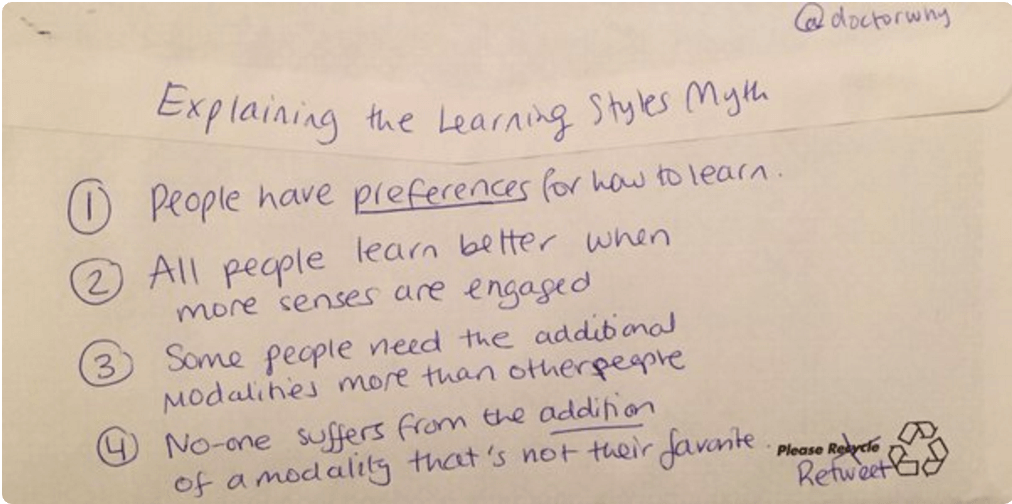 So, there you go. Adding modalities benefits some students without hurting any. But, labelling students in terms of how teachers think students think, and thus overlooking the fact that students can change, can learn new ways of thinking is harmful.
Hope that clears things up.
The Learning Spy Substack is a sharp, provocative dispatch from the front lines of education, where ideas are tested, myths are challenged, and nothing is taken for granted.
Join me on Substack