What I've learned about functional grammar
Mar 06, 2014
#Lee Donaghy
#Michael Halliday
#functional grammar
#John Polias
#Mary Schleppegrell
#systemic functional linguistics
Yesterday I had the good fortune to listen to Professor Mary Schleppegrell from the University of Michigan talk about how functional grammar is having an impact on EFL students in US schools. Ever since reading Lee Donaghy's evangelistic account of its importance I've been batting it around and trying work out what to do with it. But I'm a big fan of traditional grammar teaching and I couldn't really see the point in teaching pupils another grammar system. How would they actually use it? So beyond getting my head round the principles, I've largely ignored it.
Now though, I see the light. As Lee has said repeatedly, functional grammar is concerned with meaning whereas traditional grammar is concerned with labelling and form. I've always considered it hugely useful to be able to deconstruct sentences and have the metalanguage to talk about the ways in which texts are constructed, and now I'm well on my way to being convinced that functional grammar may be a better way to do this.
Functional grammar is more about the ‘actual meaning’ of texts and sees language as systems rather than rules. Knowledge of grammar is often used to point out so-called 'mistakes' but as Michael Lewis points out in his excellent book, The English Verb: An Exploration of Structure and Meaning native speakers never make mistakes. They may not be aware of why they choose to speak the way they do, but if there is a choice between expressions there is always a reason for the choices we make. Some crusty old git pointing out that we're wrong is massively unhelpful. The mistake, Lewis argues is to see grammar as a system of rules. It's not. It's a tool used to describe how we communicate. If a 'rule' fails to describe a valid choice made by a native speaker, it is not a very useful rule.
The argument in favour of functional grammar is that it can be hugely useful in teaching academic language in a way that parallels the ways in which we naturally learn to speak in ‘everyday’ language. The word-rich may arrive at secondary school with a good implicit understanding of traditional grammar and may well know many of the meta-linguistic terms we use to discuss language (noun, conjunction, clause) but not so the word-poor. For these pupils there is a disconnect between the way they use language and how they need to use it to succeed in school.
Here's a bit of background:
Functional grammar, or the systemic functional linguistics (SFL) theory of language and meaning, is the brainchild of professor of linguistics, Michael Halliday. SFL theory links language forms directly with the meanings they present, and offers ways of talking about language that can help pupils to directly relate to language and content.
In the Continuum Companion to Systemic Functional Linguistics, Michael Halliday proposed two levels of context: the context of culture, which he called ‘genre’, and the context of situation, or ‘register’. Genres are about how we get things done. The genre of a text or communication is determined by its purpose and there are as many different genres as there are social purposes. Genres are predictable, patterned ways of using language and can, in the context of academic disciplines, be taught explicitly to pupils.
The register of a text is broken down into three main areas: the field (what the communication is about), the tenor (who is taking part in the communication) and the mode (how things are being communicated).
John Polias calls this ‘the register continuum’. He argues that language is divided into three categories of register: everyday (informal), neutral (specialised) and academic (formal).
Informal register
- Field: stuff everyone knows.
- Tenor: the way people who know each other really well talk.
- Mode: chatting.
- Field: stuff shared by distinct interest groups (e.g. gardening, mountain biking, computer games).
- Tenor: the way you might communicate with someone you’ve never met before.
- Mode: explaining experiences that are not shared.
- Field: stuff that’s specific to particular subjects or disciplines.
- Tenor: institutional, impersonal communication.
- Mode: hypothetical, theoretical or encyclopaedic.
George’s parents gave him an axe and told him to be careful. He absolutely loved it and decided to test his strength by chopping down a tree. His father was furious and summoned his son to explain his actions. George walked slowly towards his father's study.

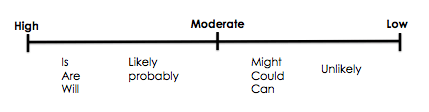
Mary also demonstrated how a 'probability continuum' could be used to help pupils understand tentativeness when making a claim in an argument.
Related posts
Some useful papers by Mary Schleppegrell:
The Learning Spy Substack is a sharp, provocative dispatch from the front lines of education, where ideas are tested, myths are challenged, and nothing is taken for granted.
Join me on Substack