
Closing the language gap: Building vocabulary
Nov 16, 2014
But words are things, and a small drop of ink, falling like dew, upon a thought, produces that which makes thousands, perhaps millions, think.
Like most teachers, as soon as pupils are sequestered in the exam hall I always used to race around trying to get my hands on the exam paper and anticipate how my eager charges will have coped. A few years ago I remember picking up the foundation tier GCSE English Literature paper and seeing a real gift of a question on the theme of dreams in Of Mice and Men. When they came streaming out I excitedly asked them if they'd done it but none of them had. Why? Because it contained the word futility, and they had no idea of its meaning. A poor vocabulary is a huge barrier to academic success.
In order comprehend a text we need to know an estimated 95% of its vocabulary[1]. This might sound surprisingly high but think about the last novel you read – how many unfamiliar words did you encounter? One or two at most? Certainly few enough that your understanding and enjoyment were not impeded. 5 percent of words might be about 10 per page – at that kind of frequency our ability to comprehend disintegrates rapidly.
Conversely, the more words you know the easier you'll find it to guess the meaning of unfamiliar words. If you know 95 percent of the words not only will you understand the text but you have a good chance of learning the other 5 percent. If you know fewer the 90 percent, then you’re probably stuffed. This leads inexorably to the Matthew Effect: the greater your vocabulary the easier you’ll find it to read and the more vocabulary you’ll acquire. After the age of 5, we acquire most new vocabulary through reading. But if we don’t read, we don’t acquire it.
Obviously the best way to build vocabulary is to read, but apparently we only learn about 15% of the vocabulary we encounter in written texts so we need to read a lot to make sure we encounter words on multiple occasions before they’ll become pert of our working vocabularies. According to one source, if you read for twenty minutes a day you’ll encounter an estimated 1,800,000 words over the course of a year whereas reading for only one minute a day will result in only 8,000 words. Now I’m not sure of the source or of the maths but if it’s only slightly true then this suggests something important. Is twenty minutes a day doable? Is this something schools can effectively mandate? I have no idea how feasible it might be to get all children reading for twenty minutes a day, but it certainly seems a worthy and relatively achievable goal.
And while we’re trying, it might also be worth putting a vocabulary building programme in place. Many schools have a word of the week or word of the day in operation, but how do they choose what words to focus on?
Vocabulary can be usefully divided into 3 tiers:
- Tier 1 – high frequency in spoken language (table, slowly, write, horrible)
- Tier 2 – high frequency in written texts (gregarious, beneficial, required, maintain)
- Tier 3 – subject specific, academic language (osmosis, trigonometry, onomatopoeia)
Consider this text:
Johnny Harrington was a kind master who treated his servants fairly. He was also a successful wool merchant, and his business required that he travel often. In his absence, his servants would tend to the fields and cattle and maintain the upkeep of his mansion. They performed their duties happily, for they felt fortunate to have such a benevolent and trusting master.[2]The words in red might well be unfamiliar to non-readers but they will certainly know the underlying concepts:
- Merchant - shop keeper
- Required - have to
- Tend - look after
- Maintain - keep going
- Performed - did
- Fortunate - lucky
- Benevolent - kind
In her fantastically useful book Bringing Words to Life, Isabelle Beck suggests there are 7,000 word families which are very high frequency in written texts and very low-frequency in speech. These are words that feature heavily in textbooks and exam papers. They are part of the language of academic success; if you're familiar with the likelihood that you will be academically successful is so much greater.
Obviously as a classroom teacher, you can’t teach all this as you wouldn’t have time to do much else, but giving pupils access to challenging texts will expose them to much more Tier 2 vocabulary than they will encounter in dumbed down, ‘student friendly’ texts.
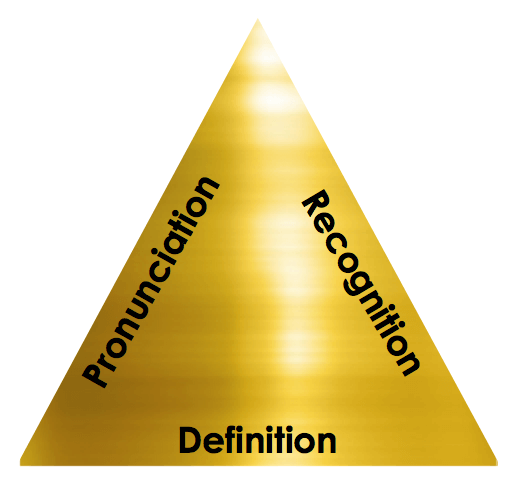 But just giving pupils challenging texts isn’t enough. If we want to make sure pupils learn this vocabulary we should concentrate on the ‘golden triangle’ of recognition, pronunciation and definition.
- Recognition – how is the word spelt? The ability to use phonics to decode new vocabulary and then to be able to reproduce the spelling makes a dig difference.
- Pronunciation – how is the word said? Making pupils say it aloud and use it in a sentence increases the likelihood they’ll remember it.
- Definition – what does the word mean? It might sound obvious, but if you know the meaning of a word, you’re much more likely to remember it.
Would it be possible for schools to use tutor time to introduce powerful Tier 2 vocabulary, focussing on the pronunciation, recognition and definition of words and then ask staff to encourage and reward pupils for using the word of the day in lessons? It strikes me this might be a lot more useful than a lot of what goes on in the name of literacy and would require little in the way of preparation and execution.
If you're interested, this might be a good place to start when selecting words we want pupils to learn:
[slideshare id=41628257&doc=tier2vocabulary-141116171723-conversion-gate02&type=d]
Do get in touch if you'd like to find out more.
[1] ED Hirsch Jr Reading Comprehension Requires Knowledge—of Words and the World
[2] Isabel Beck, Margaret McKeown, and Linda Kucan, Choosing Words to Teach
The Learning Spy Substack is a sharp, provocative dispatch from the front lines of education, where ideas are tested, myths are challenged, and nothing is taken for granted.
Join me on Substack