
Better analysis: seeing the wood AND the trees
Nov 03, 2013
I've been exploring better ways to teach analysis and evaluation for some time now. A few years ago I stumbled on the idea of zooming in and out which has gone viral and made its way into the teaching zeitgeist. In case you've managed to miss it, the basic premise is that terms like analysis are pretty slippery and hard to tie down and benefit from being explained in a more concrete way.When we read a text, or look at an image, we see it as a distinct whole.

We just see the tree. And 'the tree' is hard to analyse.
But if we then zoom in, we will be able to analyse details which would otherwise have been missed.

We can see the patterns made by the bark and the moss growing in between.
And then, if we zoom out, we can evaluate how the text relates to its context.

We can see that the tree is part of forest with its own distinct character.
So far so good. This analogy has helped many of my pupils understand how to go about reading more analytically. And I've used it to design a reading taxonomy which can be applied to any text.
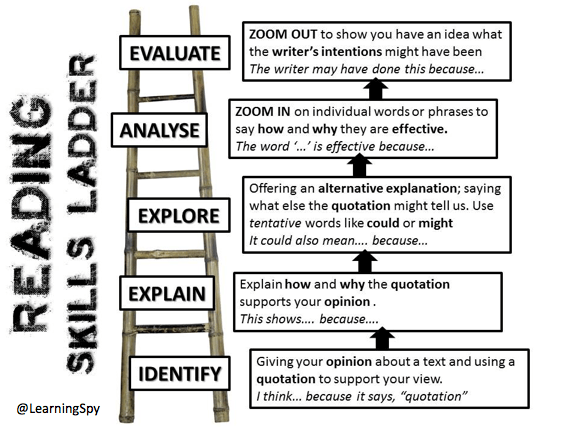
But it can still lead to situations where even the concept has been understood and pupils get the process, they'll still come up with bland repetitive comments which do little to get to the heart of a writer's intentions and techniques.
So, after stumbling across the work of Susan De La Paz and Mark Felton in Hattie's latest education tome, Visible Learning and the Science of How We Learn, I got pretty excited. De La Paz and Felton took a group of 'average to low' ability high school history students and taught them to read historical documents using a specially designed schema:
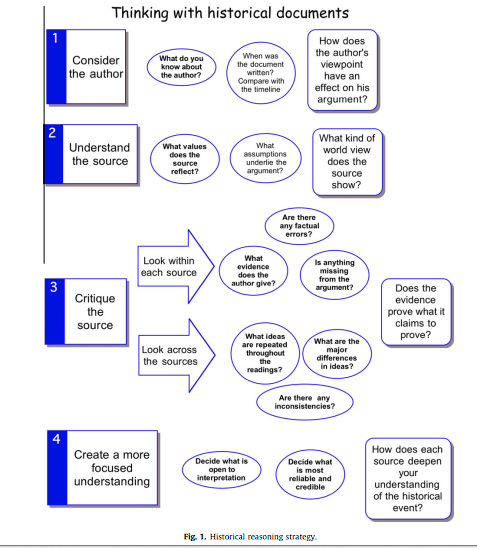
This schema was taught explicitly. Teachers spent 5 lessons explaining and modelling how it worked and scaffolding its use before allowing them two weeks to practise using it to analyse a range of historical documents. The students were given an assessment where they had to read about the Gulf of Tonkin incident and then write an essay to demonstrate their understanding. The students who had been taught to use the schema outstripped the performance of a similarly composed control group and De La Paz and Felton wrote:
Our results suggest that students developed sophisticated task representations for writing because they experienced firsthand how reading and writing strategies converge to accomplish clearly defined goals in historical writing. In this way, the inquiry process provided focus and made the purpose of reading, pre-writing and writing strategies transparent to students (Kress, 1993; Roth, 1998). We believe that scaffolding historical reasoning enhances writing because students read documents with the purpose of identifying and contrasting conflicting view- points. The work of disciplinary thinking about the documents allowed them to develop more advanced and integrated claims and rebuttals, and it lead them to cite sources more readily and more appropriately.Sounds great, doesn't it. But can this approach be applied to subjects other than history? You betcha!
I've tweaked the questions used in the research so that they could be applied to any text (and particularly, any work of literature.) The 'as you read' questions are intended to be analytical whereas the 'after you've read' question is more evaluative
Stage 1 - consider the author
As you read
- What do you know about the author?
- When was the text written?
- How does the author know about the events described?
- How does the author’s argument affected by his or her viewpoint?
Stage 2 - understand the source
As you read
- What is the genre of the text?
- Why was the text written?
- What assumptions are being made?
- What is the world view reflected by the text?
As you read
- What evidence is being given?
- Are there any mistakes?
- Is anything missing from the argument?
- Does the evidence prove what it claims to prove?
- What is open to interpretation?
- What is most reliable and credible?
- How does the text deepen your understanding of the subject?
Too often students are expected to cope with problems that demand high-level thinking and decision-making, but have not been given instructional opportunities to develop appropriate tools. [This study illustrates] how strategic thinking was taught explicitly through group instruction using both modelling and direct exhortation [and] significant gains followed from instruction targeting thinking tools students can apply to complex problems. (p. 77.)If you'd be interested in testing this out, I'd be very interested in discussing it further. And if you're really keen, my book, The Secret of Literacy: making the implicit explicit is available for pre-order.
The Learning Spy Substack is a sharp, provocative dispatch from the front lines of education, where ideas are tested, myths are challenged, and nothing is taken for granted.
Join me on Substack