
In defence of accountability
Mar 19, 2023
This weekend saw Joe Kirby publish a thoughtful blog in which he calls for an end to Quality Assurance. I agree with Joe's analysis of the causes of poor accountability - or QA - but not his suggested solutions.In his blog, Joe says that "QA warps time, trust, thinking, teaching, leadership and learning." There's no doubt that this can sometimes be true, but it runs the risk of becoming a straw man argument in which poor QA is attacked in order to justify getting rid of all QA. In order to see if Joe's arguments are true, we ought to see if they stack up against the best forms of QA.
Quality assurance is defined as "the maintenance of a desired level of quality in a service or product, especially by means of attention to every stage of the process of delivery or production." A fairly bland corporate euphemism for ensuring what we implement is of the quality we intend. On the face of it, it's difficult to argue that trying to make sure schools are doing a reasonable job of providing an education for their students is a bad thing.
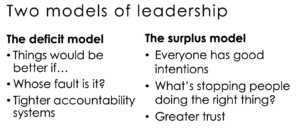 In the worst cases, this monitoring mindset can certainly lead to a deficit model of school improvement where the people who work in schools are seen as creating problems which senior leaders need to solve. This mentality often results in looking for bad actors to blame for whatever is going wrong, which leads in turn to ever tighter accountability systems which create the kind of toxic culture in which teachers live in fear and are forced into mindless compliance. The opposite approach - a surplus model of school improvement - takes the view that people who work in schools tend to be well intentioned and will only do the wrong thing due to unintended systemic obstacles which can be hunted out and removed. The result of this approach is ever greater trust in which teachers believe that senior leaders are there to provide support and repay the trust they are extended by becoming increasingly worthy of trust in a virtuous cycle.
Joe says that instead of trying to assure quality, we should look to build knowledge through CPD, keep an open mind when visiting lessons and talking to teachers, find things to praise instead of to condemn, find out what support is required and then provide it in the most minimally invasive way possible, nudge staff in the right direction and engage in meaningful dialogue about school improvement. I absolutely agree that all these things are worth doing but instead of viewing them as contra to QA, I argue that they represent a surplus model of assuring quality, or, as I described it in my 2019 book, "Intelligent Accountability".
In my view, there are 5 principles which underlie Intelligent Accountability:
- We are most likely to improve when we feel trusted
- We need to know we are accountable in order to be our best
- Intelligent accountability depends on mutual trust
- Equality is unfair
- Autonomy needs to be earned.*
But, when we extend trust wisely and hold people to account for what they've said they will do there are consistent benefits:
- Accountability helps to promote ethical and responsible behaviour. When people know that they will be held responsible for their actions, they are more likely to act in a way that is consistent with their values and societal norms.
- Accountability promotes fairness and justice. When people are held accountable for their actions, it ensures that they are held to the same standards as everyone else, regardless of their position or status.
- Accountability helps to build trust and credibility. When people are held accountable for their actions, it demonstrates that they are reliable and trustworthy, which can help to strengthen relationships and foster a sense of community.
- We know how we will be held accountable before we are judged or commit to a course of action
- We believe that whoever is holding us to account is well-informed and interested in accuracy.
- The person holding us to account does not tell us what they want or expect to see.
Of course, you can reasonably argue that compliance is much better than chaos (and you might - less reasonably - want to argue that you, in fact, know better than every one of your teachers how to teach their subject to their students) but that will take us to the final two principles of Intelligent Accountability: we should acknowledge that some teachers are much more experienced and knowledgeable than others and that it's a mistake to ignore this and treat all teachers as the same. Equally, we should be explicit that autonomy must be earned and until it is, less experienced, less effective teachers may be subject to more constraints than their colleagues.
Unless we do this, we run the very real risk that good intentions become magical thinking. Some schools and some teachers cannot simply be trusted and nudged into excellence. To be our best we all benefit from clarity, constraints and consequences applied intelligently. But to avoid being our worst we need and deserve high quality accountability.
We must avoid dichotomous thinking. We should view school improvement as CPD or QA (bad CPD is no better than bad QA) we should be striving to both as well as we can.
[*] You can read an overview of each of these principles here.
Useful references
Baumeister, R. F., & Leary, M. R. (1995). The need to belong: Desire for interpersonal attachments as a fundamental human motivation. Psychological Bulletin, 117(3), 497-529. doi:10.1037/0033-2909.117.3.497
Bicchieri, C., & Xiao, E. (2009). Do the right thing: But only if others do so. Journal of Behavioral Decision Making, 22(2), 191-208. doi:10.1002/bdm.616
Gino, F., & Pierce, L. (2010). The abundance effect: Unethical behavior in the presence of wealth. Organizational Behavior and Human Decision Processes, 111(2), 96-105. doi:10.1016/j.obhdp.2009.11.001
Greiff, S., Wüstenberg, S., Molnar, G., Fischer, A., & Funke, J. (2020). The effect of accountability on creative problem solving: The role of feedback and transparency. Journal of Creative Behavior, 54(3), 370-380. doi: 10.1002/jocb.413Lerner, J. S., & Tetlock, P. E. (1999). Accounting for the effects of accountability. Psychological Bulletin, 125(2), 255-275. doi:10.1037/0033-2909.125.2.255
Huq, A. Z., & Ginsburg, T. (2018). How to lose a constitutional democracy. University of Chicago Press.
Lerner, J. S., & Tetlock, P. E. (2003). Accountability: A social check on the fundamental attribution error. Social Psychology and the Unconscious: The Automaticity of Higher Mental Processes, 278-296. doi:10.4324/9781410608738-12
Leventhal, G. S. (1980). What should be done with equity theory? New approaches to the study of fairness in social relationships. In K. J. Gergen, M. S. Greenberg, & R. H. Willis (Eds.), Social exchange: Advances in theory and research (pp. 27-55). New York: Plenum Press. doi:10.1007/978-1-4613-3087-5_2
Papay, J. P. and Kraft, M. A. (2016). The myth of the performance plateau. Educational Leadership, 73(8), 36–42.
Tetlock, P. E., Skitka, L. J., & Boettger, R. (1989). Social and cognitive strategies for coping with accountability: Conformity, complexity, and bolstering. Journal of Personality and Social Psychology, 57(4), 632-640. doi:10.1037/0022-3514.57.4.632
Tetlock, P. E., & Kim, J. I. (1987). Accountability and judgment processes in a personality prediction task. Journal of Personality and Social Psychology, 52(4), 700-709. doi:10.1037/0022-3514.52.4.700
Tyler, T. R., & Blader, S. L. (2000). Cooperation in groups: Procedural justice, social identity, and behavioral engagement. Philadelphia, PA: Psychology Press.
Tyler, T. R., & Huo, Y. J. (2019). Trust in the law: Encouraging public cooperation and reducing crime. Russell Sage Foundation
The Learning Spy Substack is a sharp, provocative dispatch from the front lines of education, where ideas are tested, myths are challenged, and nothing is taken for granted.
Join me on Substack