
Why bother with 'turn & talk'?
Jun 07, 2024
Beyond the notion that it's nice for students to chat, or 'do oracy,' is there any real merit in getting them to talk to each other during lessons?Recently on Twitter, Barry Smith got in touch to go over all the things he sees that regularly go wrong with 'turn & talk':
- Kids don’t know a lot & simply aren’t able to articulate anything meaningful in the time given.
- Kids slow to start. Don’t have the words.
- Kids given very short time to express ideas.
- One child will dominate. Others don’t participate.
- Kids embarrassed
- Then there’s issue of kids teaching one another incorrect info.
Previously, I've written about the need to solve three distinct problems every lesson:
- How do I know if all students are paying attention?
- How do I know if all students are making sense of what I'm teaching?
- How do I know if all students are getting better that the things I want them to get better at?
Sort of like this
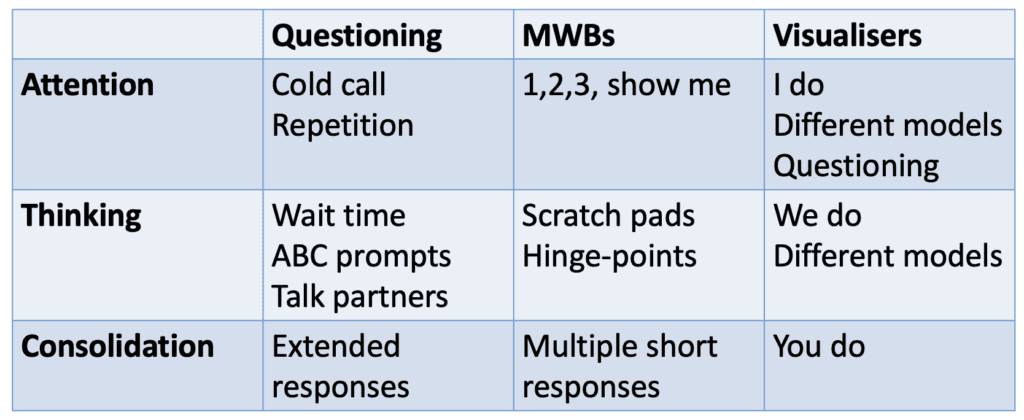
If we were to map 'turn & talk' onto this grid we'd need to ask ourselves what problem it would solve. So, does getting students to talk to each other help us to know whether they're all paying attention? No, not really. We can scan a room and get a rapid sense that all students are in engaged in talking but to find out whether they're talking about the thing we want them to talk about requires listening in to each individual conversation. We could of course wait until after the talk phase and cold call students to see if they have great contributions but all this really reveals is whether a student was definitely not attending. It's of little help in detecting whether those who are faster on their feet were actually on task. MWB routines and cold calling are better used as an efficient way to create a culture where students pay attention to you and each other.
Neither will turn & talk but much use in answering the question about students getting better at specific skills (unless you're wanting them to practise turning to each other and talking, which would, I think, be weird.)
Where T&T comes into its own is in collecting data on whether students are making sense out of the content they're encountering. Typically, when teaching I'll go through process like this:
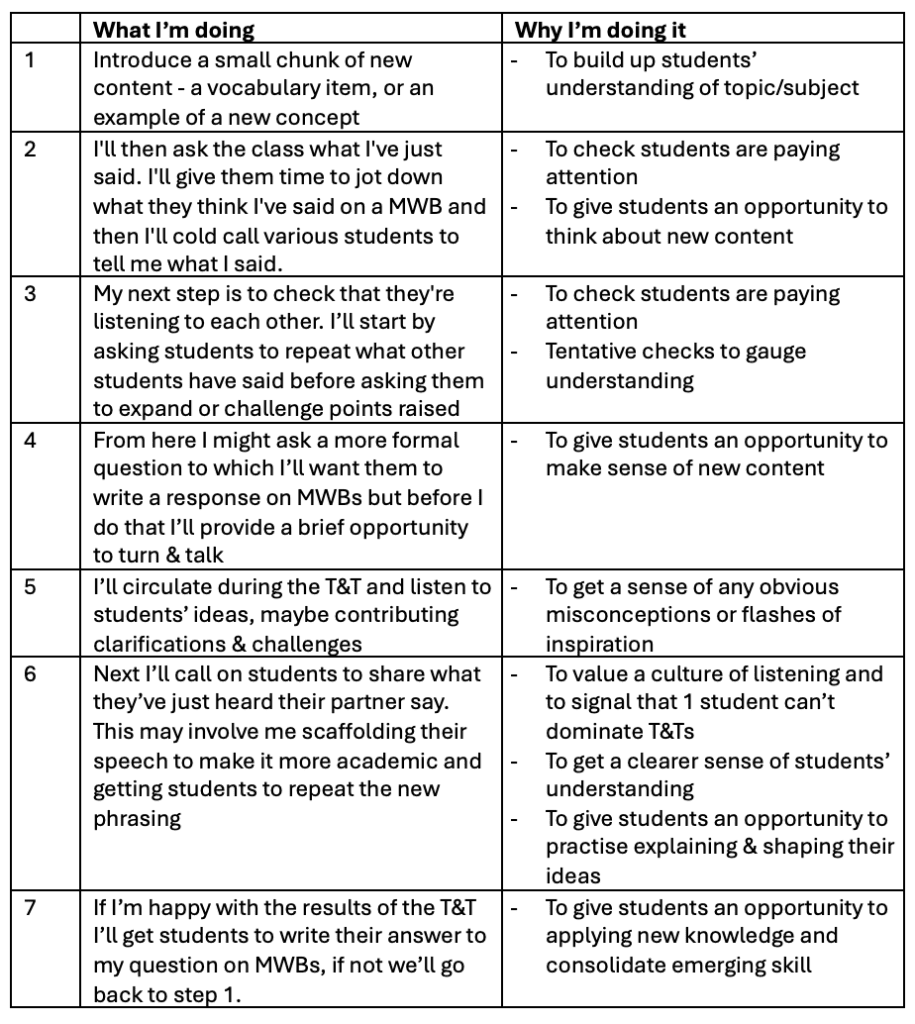
Incorporating turn and talk into this sort of process not only provides an essential opportunity for students to test out new understandings and articulate how new ideas fit within their existing view of the world, but also mitigates against most if not all of Barry's concerns about bad T&T.
- Although they may not know a lot, the process is so tightly focussed that they only have to think about how new knowledge connects to existing knowledge.
- Vocabulary is provided and modelled to ensure students get off to a quick, purposeful start
- Because focus is deliberately narrow (a 1 sentence response to a prompt) there is enough time for both students to express their understanding
- Because students are explicitly asked to share what they've heard, it's hard for 1 student to dominate
- Embarrassment is a function of unfamiliarity. If this kind of routine is regularly built into teaching sequences it quickly becomes normalised.
- Part of the point of T&T should be to identify & intercept misconceptions. (Not doing this doesn't get rid of misconception it just makes them harder to spot!)
The Learning Spy Substack is a sharp, provocative dispatch from the front lines of education, where ideas are tested, myths are challenged, and nothing is taken for granted.
Join me on Substack