
Principled curriculum design: the English curriculum
Dec 16, 2013
#Dylan Wiliam
#grammar
#Alex Quigley
#Joe Kirby
#Daisy Christodoulou
#Debra Myhill
#Threshold concepts
The tragedy of life is that one can only understand life backwards, but one must live it forwards Søren KierkegaardBack in March 2013, I wrote about the principles underlying my redesign of a Keys Stage 3 English curriculum. It received a mixed response. Since then Joe Kirby and Alex Quigley have published their ideas on redesigning this area of the curriculum and have, in different ways, influenced my thinking.
Recently, I've presented my ideas on the English curriculum to over 100 English teachers and the consensus seems to be that there is no consensus. Having thought quite a bit about that I think that might be, at least in part, because there is little agreement on why English is taught or even, more fundamentally, on what it actually is, or should be, as a subject discipline. Is it about developing empathy and being better human beings? Is it about providing pupils with transferable skills like analysis? Or is it about transmitting a culturally enriching knowledge of literature?
More generally, the purpose of education is usually described as being about the following:
- Transmission of culture
- Preparation for work
- Preparation for effective citizenship
- Preparation for life
These then are the principles on which I would design a curriculum:
- Education should enrich students’ cultural capital and teach them explicit knowledge about how to think and communicate
- Sustained progress is preferable to rapid progress; learning is distinct from performance
- Is it good enough for my own daughters?
Knowing what is considered to useful and important is powerful. In English, it follows that knowing about so-called 'Great Literature', or the cannon, is important. This view is often attacked on the grounds that teaching students to revere the works of Dead White Men is reactionary and bound to burden them with thoughts and ideas that are irrelevant to their lives and circumstances. And so, perhaps, it would be if that were what I was advocating. Knowledge is power. This isn't really a debate: the more you know, the better equipped you are to think, and no one is seriously arguing against the idea that pupils should be taught to think. The curriculum I'm proposing would seek to encourage pupils to critique the cannon, to explore the contexts in which it texts were written and to examine how our views have developed over time. To that end, my ideal English curriculum will be led by the study of great, culturally rich texts, but will also focus on criticism of them.
Grammar
But cultural capital isn't just about being able to reel off passage of Shakespeare or Keats; it's also about our ability to think and communicate. This means that knowledge of grammar is particularly powerful. I've come to believe that knowledge of grammar is foundational and transformative for two reasons.
Firstly, if we want to be taken seriously we need to know and understand the rules of communication. If we know what they are we can then break them knowingly. I wasn't taught much in the way of explicit knowledge about grammar at school and while I implicitly picked up quite a lot about how to get my thoughts across coherently, I did not have the knowledge to be able to think meta-cognitively about writing. This meant that my ability to write creatively was hampered; I wasn't able to make informed choices. I was left with doing 'what felt right'.
But grammar is also important in helping us think analytically. Grammar is concerned with meaning and if we want to give our pupils the freedom to think and succeed academically, we need to teach the language to do so. In English we need to teach pupils to 'think like an essay'. Daisy Christodoulou explains this with reference to one of her student's work:
JB Priestley also presents Mr Birling as confident he says to Gerald with no hesitation at all ‘But what I wanted to say is there’s a fair chance that I might find my way into the next Honours List’ he shows he’s confident in his business and in himself and he’s not telling Gerald he’s going to have a knighthood he’s boasting.
Her point was that although this is clearly a bright student, his lack of grammatical knowledge means that his thoughts are sloppy. She rewrote his words as follows:
JB Priestley also presents Mr Birling as confident when he says to Gerald with no hesitation at all, ‘But what I wanted to say is there’s a fair chance that I might find my way into the next Honours List’. Here, he shows he’s confident in his business and in himself. He’s not just telling Gerald he’s going to have a knighthood; he’s boasting about it.
Daisy argues that the best way to teach grammar is through decontextualised drill. The alternative, typified by Debra Myhill's Grammar for Writing approach is problematic. If you want to teach grammar in context, you have two choices. You either give them feedback on their writing which concentrates just on the grammatical knowledge which you are engaged in actively teaching on the time, or you give them feedback on all the grammatical mistakes in every piece of work. If you take the first approach you will be forced to ignore certain mistakes and allow pupils to embed bad habits. Practice makes permanent and pupils become skilled at what they practise doing. If on the other hand you pick them up on every mistake you run the risk of overloading their working memory with the result that they will fail to learn anything. But if grammar is taught systematically and out of context then pupils will be able to master grammatical knowledge before moving on to the next step.
To this end, I would recommend separate grammar lessons. If you currently have 4 English lessons a week and Key Stage 3 then you might consider making one of these lessons a grammar lesson.
Sequencing
That said, I'd accept that there are times when we are likely to learn better in context. It just so happens that the most effective context for grammar teaching is that it follows its own discrete narrative from word classes to sentence structure to whole text structure and coherence. Daisy suggests the following sequence for teaching grammar:
[caption id="attachment_4854" align="aligncenter" width="300"]
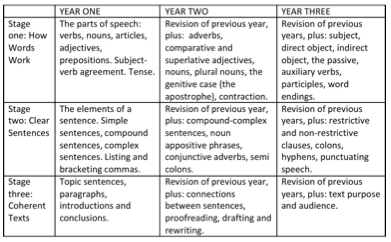 Daisy Christodoulou's teaching sequence for grammar[/caption]
As Joe puts it,
This English curriculum spins the globe... Its chronology is sequential, which will leave students will a memorable framework in their minds for understanding any cultural achievements of the past they may come across. In the future, this ancient, medieval, renaissance and modern framework should help them peg new ideas to their prior conception of the eras.There a couple of caveats here.
1) Harry Fletcher-Wood has raised some interesting thoughts about why the chronological teaching of history might not be the best idea. But I'm not teaching history. The threshold concepts of English should be should be interleaved within the sequenced teaching of literature.
2) The programme of study below is arranged thematically as well as sequentially. Within each scheme of learning there should be links stretching backward and forwards to show how literature is rooted in what has come before and how it influences what comes after.
This then is my updated redesign of the Key Stage 3 curriculum:
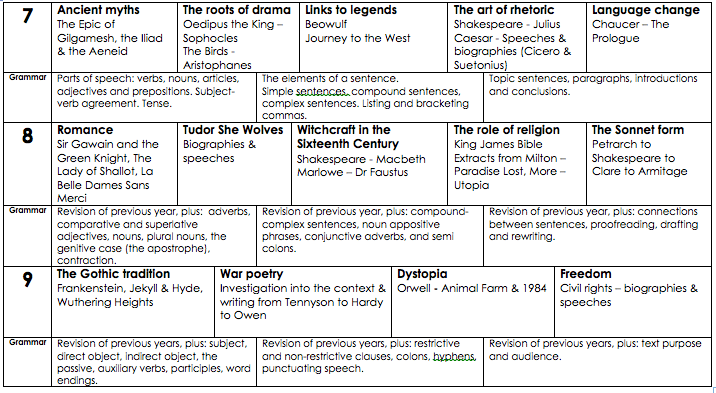

NB I'm not for a moment arguing that these are the 'right' texts - I would hope that English teachers would want to select their own preferences from within this suggested sequence. I'm not at all sure for instance of my inclusion of Th History Boys in Year 10. I was swayed by the fact that it's now the nation's favourite play, but you might very well think that it might not be appropriate.
Sustained progress
The second strand of the principles which underpin this curriculum is the idea that we should seek to ensure pupils learning is sustained. I've argued before that the concept of 'rapid progress' actively undermines the likelihood the pupils will make sustained progress. I would add that the way in which schools generally design their curriculum is to maximise students' short-term performance at the cost of the long-term retention and transferability of what they 'learn'. For this reason I contend that programmes of study which block the teaching of skills are destined to fail. The line we're sold by exam boards is that because English is a 'skills based subject' we should design our programmes of study to take advantage of the transfer of skills from one area of the curriculum to another.
This leads to schools designing a curriculum that might look a bit like this:

We would expect that the skill of analysing non fiction learned in term 1 would transfer to the skill of writing non fiction in term 2 and the skill of analysing poetry in term 3. Except it doesn't. English teacher know it doesn't because every year they're faced with classes who haven't been able to transfer the skills and are left feeling like it must be their fault for teaching so badly. The problem is that the link is obvious to us as expert teachers with a huge breadth and depth of knowledge around the subject and we assume that it must be equally obvious to our pupils, if only we could explain it well enough. The trouble is that experts and novices think very differently and require explicit teaching each time we move to a new subject area.
Instead, if we space and interleave our curriculum and introduce certain 'desirable difficulties' which slow the progress of short-term performance but increase the likelihood of long-term retention, pupils will be far more likely to be able to transfer their learning between different parts of the curriculum.Threshold concepts
If we are going to successfully interleave our teaching, we have to break English down into those areas which are fundamental to understanding the subject. These areas, or threshold concepts, are transformative and irreversible. Once you've learned them you pass through a threshold and can never see the wold in quite the same way again. Before you learn to decode writing is just funny squiggles. But once decoding is learned, you will only be able to see letters. When I first started thinking about threshold concepts in English I was unable to find anyone who'd done any work in this area and this remains the case. There are some excellent general overviews, but nothing specific.
This though is an important consideration:
Threshold concepts would seem to be more readily identified within disciplinary contexts where there is a relatively greater degree of consensus on what constitutes a body of knowledge (for example, Mathematics, Physics, Medicine). However within areas where there is not such a clearly identified body of knowledge it might still be the case that... ways of thinking and practising also constitutes a crucial threshold function in leading to a transformed understanding.Maybe there aren't any real threshold concepts in English; maybe there are only 'ways of thinking and practising'. If that is the case, the ways of think and practising that I would suggest we interleave in our curriculum are these:
Meyer and Land, Threshold Concepts and Troublesome Knowledge: Linkages to Ways of Thinking and Practising within the Disciplines p 9
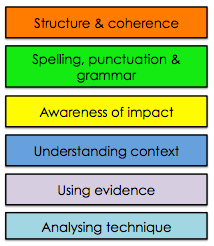
- Structure and coherence is the understanding that texts are put together with intent. Once you understand this, you think differently about the way you write.
- Spelling, punctuation & grammar has already been dealt with above. It's probably a bit clunky to lump these 3 together; SPaG as a concept is widely understood by teachers as being concerned with accuracy but it is also a component of the third writing concept:
- Awareness of impact is the understanding that writing is shaped by the priorities of a writer and the needs of a reader. it would include the teaching of genre, audience and purpose.
- Understanding context is crucial to making sense of texts. Once we understand that a context of production and reception shapes meaning we will never read in the same way again.
- Using evidence is often reduced to simply formulas for using quotations but is rather about shaping a critical response by interpreting the thoughts of the writer directly.
- Analysing technique is about the understanding that writers use a variety of linguistic and structural techniques to achieve their ends.
If it's good enough for my own daughters, then it's good enough
This is the English curriculum I wish I'd had. And it's the curriculum I want for my daughters. I absolutely want them to explore and encounter some of the wonderful texts which make up the cannon of English Literature and I also want them to interrogate these texts and decide whether they find them worthy or wanting. Does this mean that it's good enough for other people's children? It had damn well better be! That's the point of these principles after all. I'm not simply feeding my daughters a burger to demonstrate the juicy goodness of British beef - I want it to be the right of all children to experience a curriculum like this.
These then are the ideas and principles which underlie my thoughts about curriculum design. If you don't like my curriculum and have an alternative you think better, that's great. The enacted curriculum is always much more powerful than the design curriculum as teachers will always mediate these plans through the lens of their own values and principles. I'd allow that as long as you're able to talk though your thinking in the way I've modelled, I'm sure your curriculum will be worth teaching.
The Learning Spy Substack is a sharp, provocative dispatch from the front lines of education, where ideas are tested, myths are challenged, and nothing is taken for granted.
Join me on Substack